
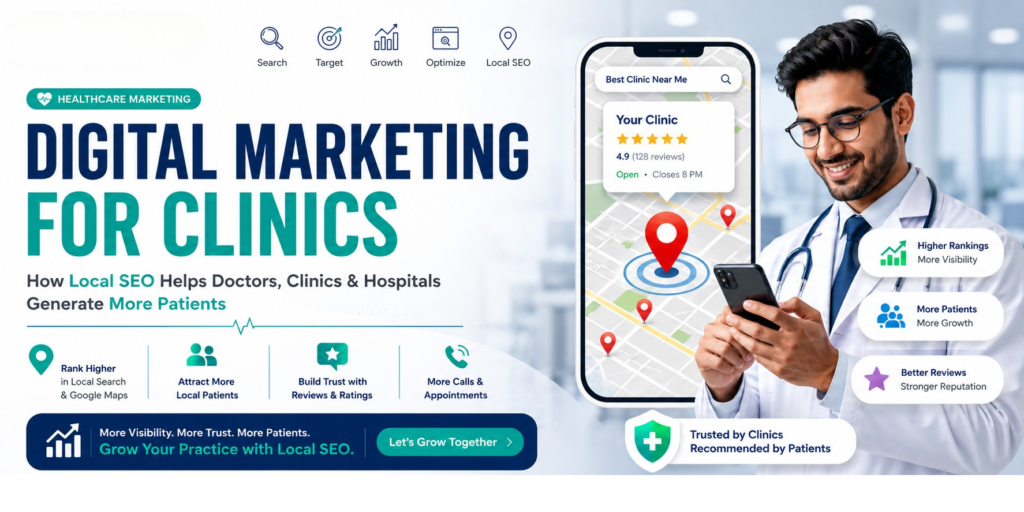
Imagine a patient searching for “best dentist near me” or “orthopedic doctor in Delhi.” Within seconds, Google displays a list of nearby clinics, complete with ratings, reviews, business hours, directions, and contact details. Most patients choose one of the first few results without scrolling further.
This is how healthcare decisions are made today.
The modern patient journey begins online. Whether someone needs a general physician, dermatologist, paediatrician, physiotherapist, or diagnostic center, their first instinct is to search on Google. If your clinic or hospital isn’t visible in those local search results, you’re likely missing out on valuable patient appointments every day.
This is where Digital Marketing for Clinics becomes a game changer. Among the many digital marketing strategies available, Lead Generation through Local SEO stands out as one of the most effective, sustainable, and cost-efficient ways to attract new patients. Local SEO ensures your healthcare practice appears in front of people actively searching for medical services in your area, right when they’re ready to book an appointment.

Unlike traditional advertising, Local SEO targets high-intent users. These are individuals who are already looking for a healthcare provider, making them far more likely to convert into patients. By optimizing your Google Business Profile, improving your website, earning positive patient reviews, and creating locally relevant content, your clinic can build trust, improve visibility, and generate consistent patient inquiries.
In this comprehensive guide, you’ll learn:
• What Local SEO is and why it matters for healthcare.
• How patients search for doctors and hospitals today.
• The key elements of a successful Local SEO strategy.
• Practical tips to improve your clinic’s online presence.
• Common mistakes to avoid.
• How One Marketing Tek can help your healthcare business achieve long-term growth through ethical and effective digital marketing.
Table of Contents
- Understanding Local SEO
- Why Local SEO Matters for Healthcare Providers
- How Patients Search for Doctors Today
- Benefits of Local SEO for Clinics and Hospitals
- The Role of Google Business Profile
- Google Maps Optimization
- Healthcare Website SEO
- Local Content Marketing
- Online Reviews and Reputation Management
- Local Citations and NAP Consistency
- Technical SEO for Healthcare Websites
- Mobile Optimization and Voice Search
- Common Local SEO Mistakes
- Best Practices for Healthcare SEO
- Pro Tips
- Local SEO Checklist
- Frequently Asked Questions
- Conclusion
What Is Local SEO?
Local SEO (Local Search Engine Optimization) is the process of optimizing your online presence so that your clinic, hospital, or healthcare practice appears in local search results when potential patients search for medical services nearby.
Unlike traditional SEO, which focuses on ranking for national or global searches, Local SEO is designed to help businesses appear in geographically relevant searches. For healthcare providers, this is especially important because patients typically look for medical services close to where they live or work.
For example, a patient might search for:
- Best dentist near me
- Pediatrician in Delhi
- Skin specialist in Mohali
- Orthopedic doctor in Chandigarh
- Eye hospital in Gurgaon
- Physiotherapy clinic near me
When these searches are performed, Google displays a combination of organic search results and the Local Pack—a map with three highlighted businesses. Appearing in these results dramatically increases your chances of attracting new patients.
Why Local SEO Is Different
Traditional marketing often casts a wide net, hoping to capture attention. Local SEO is more targeted. It connects your practice with people who are already searching for the exact services you provide in your area.
This means:
- Higher-quality leads.
- Better conversion rates.
- Lower customer acquisition costs.
- Sustainable long-term growth.
Why Local SEO Matters for Doctors, Clinics, and Hospitals
Healthcare is one of the most trust-sensitive industries. Patients don’t simply choose the closest clinic—they choose the one they trust the most.
When comparing healthcare providers, patients often evaluate:
- Google ratings and reviews.
- Clinic location.
- Doctor qualifications.
- Website quality.
- Available services.
- Clinic photos.
- Consultation hours.
- Ease of booking.
A strong Local SEO strategy helps you present the right information at the right time, making it easier for patients to choose your practice over competitors.
Key Benefits of Local SEO
Increased Online Visibility
The higher your clinic ranks in local search results, the more likely patients are to discover your services. Improved visibility leads to more website visits, phone calls, and appointment bookings.
Better Quality Leads
Local SEO targets users who are actively looking for healthcare services. This means the traffic you receive is more likely to convert into actual patients.
Stronger Patient Trust
An optimized Google Business Profile with positive reviews, updated photos, and accurate information builds credibility before a patient even contacts your clinic.
Long-Term Return on Investment
Unlike paid advertising, where visibility ends when your budget runs out, Local SEO continues to deliver value over time. Once your clinic earns strong rankings, ongoing optimization helps maintain and improve your position.
How Patients Search for Healthcare Services Today
The way patients find healthcare providers has changed dramatically over the past decade. Digital behavior now plays a significant role in the decision-making process.
A typical patient journey looks like this:
Step 1: Identify a Need
A person experiences a health concern, such as a toothache, skin irritation, or persistent back pain.
Step 2: Search Online
They search Google using phrases like:
- Best dentist near me
- Child specialist in Delhi
- Skin clinic in Mohali
- Orthopedic doctor open today
Step 3: Compare Options
Patients compare several healthcare providers based on:
- Reviews.
- Ratings.
- Distance.
- Services offered.
- Website quality.
- Photos.
- Consultation fees (if available).
Step 4: Visit the Website
Before booking, many patients explore the clinic’s website to learn more about:
- Doctor profiles.
- Specialties.
- Treatments.
- Patient testimonials.
- Appointment booking options.
Step 5: Make Contact
If the online experience is positive, the patient calls the clinic, fills out a contact form, or books an appointment online. Every stage of this journey is influenced by your Local SEO strategy.
Local SEO vs Traditional Advertising
| Traditional Advertising | Local SEO |
| Targets a broad audience | Targets patients actively searching for healthcare services |
| Expensive recurring costs | Long-term investment with lasting benefits |
| Difficult to measure ROI | Clear performance metrics and analytics |
| Limited campaign duration | Continuous online visibility |
| Lower purchase intent | High-intent users ready to book appointments |
| Limited personalization | Highly relevant local search results |
Google Business Profile: The Foundation of Local SEO
Your Google Business Profile (formerly Google My Business) is one of the most powerful tools for attracting local patients. It serves as your digital storefront, appearing in both Google Search and Google Maps.
An optimized profile increases your chances of appearing in the coveted Local Pack and provides patients with the information they need to contact or visit your clinic.
Essential Elements of a High-Performing Google Business Profile
- Accurate business name.
- Complete address.
- Local phone number.
- Website URL.
- Updated consultation hours.
- Relevant business categories.
- Comprehensive list of services.
- High-quality clinic photos.
- Regular posts and updates.
- Prompt responses to patient reviews.
Google rewards businesses that keep their profiles accurate, complete, and active. Regular updates signal that your practice is engaged and trustworthy.
Google Maps SEO: The Secret to Getting More Patient Appointments
When someone searches for “dentist near me”, “orthopedic doctor in Delhi”, or “best skin clinic in Mohali,” Google usually displays a map with three businesses before showing the regular search results. This section is known as the Google Local Pack, and appearing here can significantly increase your clinic’s visibility.
For healthcare providers, ranking in Google Maps is often more valuable than ranking #1 in traditional organic search because patients can immediately view your location, ratings, operating hours, phone number, and directions.
How Google Determines Local Rankings
Google evaluates three primary factors when ranking healthcare businesses in local search:
1. Relevance
Google assesses how closely your Google Business Profile matches the patient’s search query. A complete profile with detailed service descriptions, accurate categories, and relevant keywords improves your relevance.
Example:
If your clinic specializes in orthodontics but your profile only lists “Dental Clinic,” Google may not show your practice for searches like “Invisalign specialist near me.”
2. Distance
Google considers how close your clinic is to the searcher’s location. While you can’t change your physical location, you can strengthen your relevance through optimized local content and accurate business information.
3. Prominence
Prominence reflects your clinic’s online authority and reputation. Google looks at signals such as:
- Number and quality of patient reviews
- Website authority
- Local backlinks
- Media mentions
- Citations across trusted directories
- Business profile activity
Optimizing Your Google Business Profile
A well-maintained Google Business Profile is the cornerstone of Lead Generation through Local SEO.
Complete Every Section
Many healthcare providers only add their clinic name and phone number. Completing every available section sends stronger trust signals to Google and helps patients make informed decisions.
Include:
- Business description
- Medical specialties
- Consultation timings
- Emergency services (if applicable)
- Accessibility information
- Appointment booking links
- Accepted payment methods
- Insurance information (where appropriate)
Select the Right Categories
Choose the most accurate primary category and relevant secondary categories.
Examples include:
- Medical Clinic
- Hospital
- Dental Clinic
- Dermatologist
- Pediatrician
- Physiotherapist
- Diagnostic Center
- Eye Care Center
Avoid choosing unrelated categories simply to appear for more searches. Relevance is more important than quantity.
Upload High-Quality Photos
Patients often judge a clinic before visiting. Professional, authentic images build confidence and increase engagement.
Consider uploading:
- Reception area
- Consultation rooms
- Treatment rooms
- Medical equipment
- Staff members
- Exterior signage
- Waiting area
- Parking facilities
Regularly updating your photo gallery signals that your business is active.
Healthcare Website SEO: Turning Visitors into Patients
Your website is more than an online brochure—it should serve as your primary patient acquisition platform.
A high-performing healthcare website should answer patients’ questions, showcase expertise, and make it easy to book appointments.
Essential Website Pages
• Home
• About Us
• Doctor Profiles
• Individual Service Pages
• Treatments
• Contact
• Appointment Booking
• Patient Testimonials
• Blog
• Privacy Policy
Each service should have its own dedicated page rather than combining multiple treatments into one.
Example: Instead of Services, create individual pages for:
• Dental Implants
• Root Canal Treatment
• Teeth Whitening
• Braces
• Pediatric Dentistry
This improves keyword targeting and provides a better user experience.
Create Location-Specific Landing Pages
If your healthcare practice operates in multiple cities or serves different areas, create dedicated landing pages for each location.
For example:
• Dentist in Chandigarh
• Dentist in Mohali
• Dentist in Panchkula
Each page should contain:
• Unique content
• Local patient testimonials
• Google Map embed
• Local landmarks
• Area-specific FAQs
• Contact details
Avoid copying the same content across multiple location pages.
Medical Content Marketing: Educate Before You Sell
Patients trust healthcare providers who educate rather than simply advertise.
Publishing informative articles helps answer common patient questions while improving your search visibility.
Blog Ideas
- Signs You Should Visit a Dentist
- How to Prevent Gum Disease
- Best Foods for Heart Health
- Knee Pain: Causes and Treatment Options
- Understanding Diabetes Symptoms
- How Often Should You Get a Full Body Checkup?
Educational content also increases the likelihood of earning backlinks from other websites.
Write Content That Answers Patient Questions
Google increasingly rewards content that satisfies search intent.
Instead of writing for search engines, write for patients.
Answer questions such as:
- When should I visit an orthopedic doctor?
- Is root canal treatment painful?
- How long does physiotherapy take?
- What causes chronic migraines?
- How can I reduce high blood pressure naturally?
Well-structured answers can also appear in Google’s Featured Snippets.
Online Reviews: One of the Strongest Ranking Signals
Patient reviews influence both search rankings and decision-making.
A clinic with hundreds of positive reviews is naturally more trustworthy than one with very few.
Encourage Genuine Reviews
Ask satisfied patients to leave reviews after successful appointments.
The best time to request feedback is:
- After treatment completion
- Following successful follow-up visits
- Through SMS or email
- Via QR codes at reception
Never purchase fake reviews or offer incentives, as this violates Google’s guidelines.
Respond to Every Review
Whether the feedback is positive or negative, respond professionally.
Positive responses demonstrate appreciation. Negative responses show that your clinic values patient concerns and is committed to continuous improvement
Build Consistent Local Citations
A citation is any online mention of your clinic’s:
- Name
- Address
- Phone Number (NAP)
Consistency across the internet improves Google’s confidence in your business information.
Healthcare providers should ensure their details are identical across:
- Healthcare directories
- Local business directories
- Hospital listings
- Medical associations
- Social media profiles
Even small inconsistencies—such as abbreviating “Road” as “Rd.” on one platform and spelling it out on another—can weaken local trust signals.
Technical SEO: The Foundation Behind Great Rankings
Patients never see technical SEO, but search engines do.
A technically sound website helps Google crawl, understand, and rank your pages more effectively.
Essential Technical SEO Elements
- HTTPS security
- XML sitemap
- Robots.txt
- Mobile responsiveness
- Fast loading speed
- Clean URL structure
- Canonical tags
- Schema markup
- Broken link monitoring
Regular technical audits help identify issues before they impact rankings.
Mobile Optimization Is No Longer Optional
Most healthcare-related searches now happen on smartphones.
Patients expect:
- Fast-loading pages
- Easy navigation
- Click-to-call buttons
- Online appointment booking
- Readable text without zooming
A slow or poorly designed mobile website often results in visitors leaving before booking an appointment.
Voice Search Is Changing Healthcare SEO
With the rise of voice assistants, more patients are asking conversational questions.
Examples include:
- “Where is the nearest pediatrician?”
- “Which dentist is open today?”
- “Find an orthopedic clinic near me.”
To optimize for voice search:
- Use natural language.
- Include FAQ sections.
- Answer complete questions.
- Focus on local intent.
Keep business information accurate.
Local SEO vs Google Ads
| Local SEO | Google Ads |
| Long-term investment | Immediate visibility |
| Builds trust organically | Stops when the budget ends |
| Lower long-term acquisition cost | Continuous advertising expense |
| Generates consistent traffic | Traffic depends on spending |
| Strong brand authority | Limited trust compared to organic results |
The most successful healthcare practices often combine both strategies, using Google Ads for immediate visibility while building long-term growth through Local SEO.
Real-World Example
Imagine two dental clinics in the same city.
Clinic A has:
- An optimized Google Business Profile
- 250 positive reviews
- Fast website
- Dedicated service pages
- Weekly educational blogs
- Accurate local citations
Clinic B has:
- An outdated website
- Few reviews
- No blog
- Incomplete business profile
- Slow-loading pages
Even if both clinics provide excellent treatment, Clinic A is far more likely to attract new patients because it is easier to discover, appears more trustworthy, and offers a better online experience.
Common Local SEO Mistakes Healthcare Businesses Should Avoid
Even experienced healthcare providers often overlook critical aspects of Local SEO. Avoiding these mistakes can significantly improve your online visibility and patient acquisition.
1. Ignoring Google Business Profile
Creating a profile is only the first step. An incomplete or outdated profile can reduce your visibility in local search results.
2. Inconsistent NAP Information
Your Name, Address, and Phone Number (NAP) should remain identical across your website, Google Business Profile, healthcare directories, and social media platforms.
3. Using Duplicate Content
Copying the same content across multiple service or location pages can confuse search engines and weaken rankings. Every page should provide unique, valuable information.
4. Neglecting Patient Reviews
Patients rely heavily on reviews when choosing a healthcare provider. Failing to encourage and respond to reviews can hurt both trust and local rankings.
5. Targeting Only Broad Keywords
Trying to rank for terms like “doctor” or “hospital” is highly competitive. Focus on specific, location-based keywords such as “best pediatrician in Noida” or “dental implants in Mohali.“
6. Slow Website Speed
A slow-loading website increases bounce rates and frustrates potential patients. Optimize images, enable browser caching, and use reliable hosting.
7. Poor Mobile Experience
If your website isn’t mobile-friendly, you’ll lose a significant portion of potential patients who search on smartphones.
8. Missing Schema Markup
A healthcare-specific schema helps search engines understand your practice and can improve how your pages appear in search results.
9. Not Tracking Performance
Without analytics, it’s difficult to know which strategies are generating appointments and which need improvement.
10. Publishing Thin Content
Short, generic pages rarely rank well. Provide detailed, informative content that answers patient questions and demonstrates expertise.
Best Practices for Healthcare Local SEO
To build a sustainable online presence, follow these proven best practices:
• Optimize every page with a clear primary keyword and supporting semantic keywords.
• Keep your Google Business Profile updated with accurate information.
• Publish informative blog articles consistently.
• Create dedicated pages for each medical service.
• Build location-specific landing pages for each clinic or branch.
• Use high-quality, original images with descriptive alt text.
• Encourage satisfied patients to leave genuine Google reviews.
• Respond professionally to all reviews.
• Ensure your website is mobile-friendly and loads quickly.
• Implement HTTPS for secure browsing.
• Add FAQ sections to answer common patient queries.
• Use internal links to guide users to related services and articles.
• Earn backlinks from trusted healthcare and local websites.
• Monitor your website through Google Search Console and Google Analytics.
• Regularly audit your technical SEO to identify and fix issues.
Pro Tips from Healthcare SEO Experts
• Focus on educating patients rather than promoting services.
• Write blogs around real questions patients ask during consultations.
• Add doctor profiles with qualifications, experience, and areas of expertise.
• Use clear calls to action such as “Book an Appointment” or “Call Now.”
• Include patient testimonials to build credibility.
• Showcase certifications, awards, and memberships.
• Optimize images for faster loading.
• Add structured data (schema markup) to improve search visibility.
• Share your blog posts on social media to increase reach.
• Monitor competitors and identify opportunities to improve your content and local presence.
Local SEO Checklist for Doctors, Clinics, and Hospitals
Use this checklist to strengthen your Local SEO strategy:
Google Business Profile
• Verified profile
• Accurate business information
• Correct categories
• Updated operating hours
• High-quality photos
• Regular posts
• Patient reviews
• Prompt review responses
Website
• Mobile-friendly design
• Fast loading speed
• HTTPS enabled
• Optimized title tags and meta descriptions
• Individual service pages
• Clear contact information
• Online appointment booking
• Internal linking
• XML sitemap
• Schema markup
Content
- Publish one informative healthcare blog each week.
- Update older content regularly.
- Include FAQs on service pages.
- Use natural, location-based keywords.
Reputation Management
- Encourage reviews.
- Respond to all feedback.
- Monitor online mentions of your clinic.
Frequently Asked Questions
1. What is Local SEO for healthcare?
Local SEO helps healthcare providers improve their visibility in local search results and Google Maps, making it easier for nearby patients to find and contact them.
2. How long does Local SEO take to show results?
Most clinics notice measurable improvements within three to six months, depending on competition and the consistency of optimization efforts.
3. Is Local SEO better than paid advertising?
Local SEO provides long-term, sustainable visibility, while paid advertising delivers immediate traffic but stops generating results once the budget ends. A balanced strategy often combines both.
4. Why are Google reviews important?
Positive reviews build trust with potential patients and are an important factor in local search rankings.
5. Can hospitals benefit from Local SEO?
Yes. Hospitals, multi-specialty clinics, diagnostic centers, and specialty practices all benefit from stronger local visibility and improved patient acquisition.
Conclusion
Healthcare has become increasingly digital, and patients now expect to find accurate, trustworthy information online before choosing a doctor or hospital. Investing in Digital Marketing for Clinics and Lead Generation through Local SEO helps healthcare providers improve visibility, build trust, and attract qualified patient inquiries.
By optimizing your Google Business Profile, creating valuable healthcare content, maintaining a technically sound website, and encouraging patient reviews, you can establish a strong local presence that supports long-term growth.
At One Marketing Tek, we specialize in helping healthcare businesses grow through ethical, data-driven digital marketing strategies. From Local SEO and website optimization to content marketing and online reputation management, our team works with clinics, hospitals, and healthcare professionals to increase online visibility and generate more patient appointments.
Ready to grow your practice? Contact one of the best healthcare marketing agencies today and discover how our Healthcare SEO solutions can help you reach more patients and achieve sustainable growth.